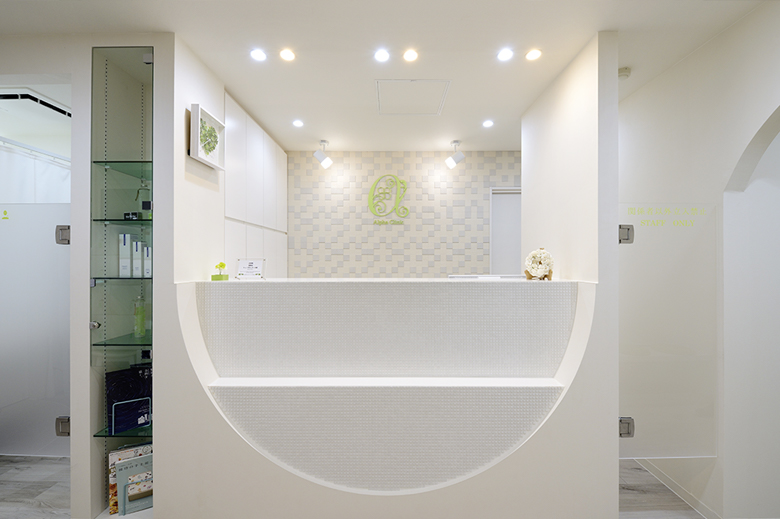
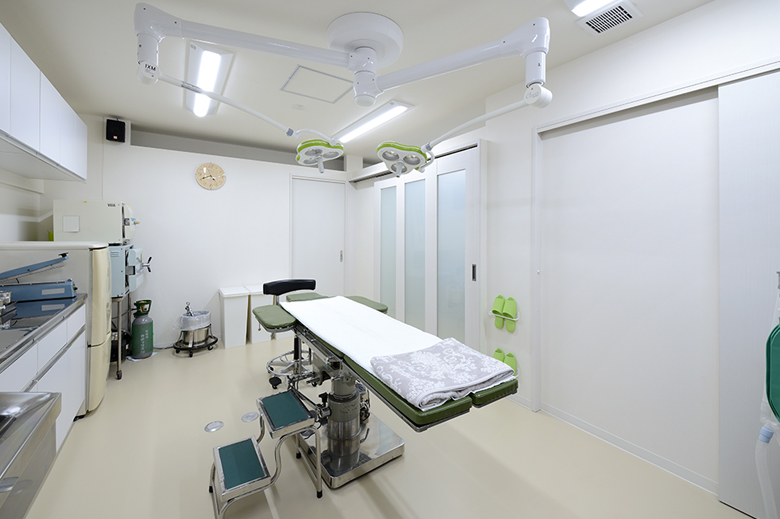
Our clinic focuses on facial lifting and offers facelifts, thread lifts, Ultraformer MPT (a medical HIFU device), injections and surgery to improve sagging around the eyes. At your consultation, the doctor will examine you and explain the options available to you. For the cost of each treatment, please see our Prices page.
Facelift
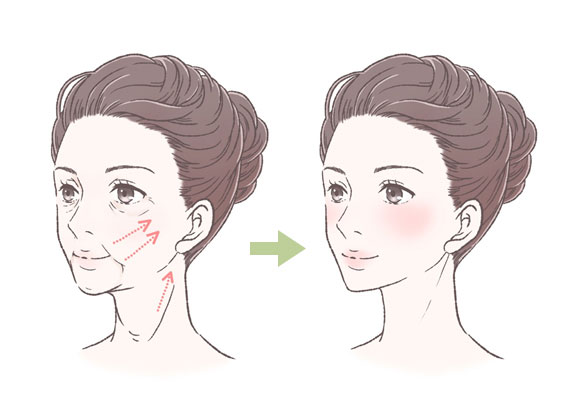
A facelift is surgery to improve sagging of the face, and it is the core treatment at our clinic. The incision follows the contour of the ear and is placed where it is less noticeable.
Threads and lasers are also options; when sagging is more noticeable and you want the results to last longer, a facelift may be worth considering. Rather than lifting the SMAS (superficial musculoaponeurotic system) alone, we first release the retaining ligaments and then lift and secure the skin and SMAS together.
Depending on where the sagging is and how pronounced it is, options include an SMAS facelift through a pre-auricular incision (in front of the ear), a deep plane facelift, a MACS lift and a forehead lift.
This may suit you if
- You are concerned about sagging around the cheeks, nasolabial folds or jawline
- You want the lifting effect to last longer
Temple lift
A temple lift can improve sagging of the upper eyelids, the outer corners of the eyes and the nasolabial fold area. The incision is made at the hairline of the temple and the tissues are lifted upward; the incision is placed where it is less noticeable. The aim is to lift the sagging cheeks that deepen the nasolabial folds and to improve wrinkles at the outer corners of the eyes.
The surgery takes about 2 hours. It is performed under local anesthesia only, and no hospital stay is needed.
This may suit you if
- You are concerned about drooping around the eyes
- You are concerned about your nasolabial folds
Thread lift
MAX THREAD is an absorbable thread made of PCL (polycaprolactone) with continuous barbs (cogs). It is designed for stronger lifting and is used for lifting without cutting the skin.
The small barbs on the fine thread catch the tissue and are designed to lift the cheeks and the corners of the mouth and to tighten sagging contours. The skin is not cut at all during the procedure; instead, a blunt needle (cannula) carrying the thread is inserted under the skin. When the cannula is withdrawn, only the thread remains in the skin.
The threads are medical absorbable threads and are absorbed by the body in about a year and a half. Collagen fibers form as they are absorbed, which is intended to help the lifting effect and firmness last (results vary from person to person).
In addition to MAX THREAD, we also offer BN lift threads made of PDO (polydioxanone). For thread types and numbers of threads, please see our Prices page.
About MAX THREAD and BN lift
- Approval status
- MAX THREAD and BN lift, used in this treatment, are medical devices that have not been approved under Japan’s Pharmaceuticals and Medical Devices Act.
- How they are obtained
- They are imported at the physician’s discretion and under the physician’s responsibility.
- Similar products approved in Japan
- At present, we have not been able to confirm any similar thread lift product approved in Japan.
- Safety information from overseas
- Overseas, complications of thread lifts such as infection, thread exposure, uneven skin surface and thread migration have been reported.
HIFU (Ultraformer MPT)
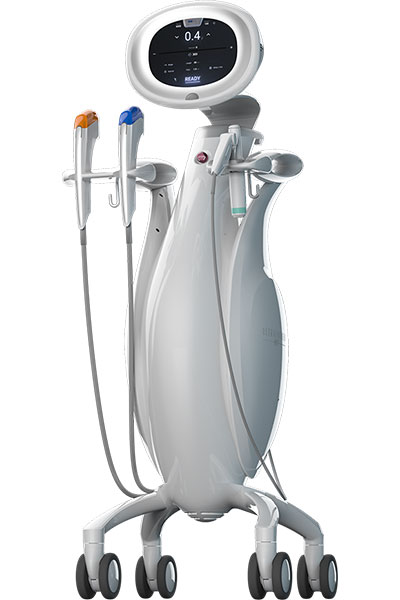
Ultraformer MPT is an aesthetic medical device that uses HIFU (high-intensity focused ultrasound). It was developed by CLASSYS of South Korea as the successor to Ultraformer III.
It focuses heat energy on the layers involved in sagging — the superficial dermis, the deep dermis and the fascia — and can be used to lift the whole face, improve age-related wrinkles and reduce fat under the chin.
How HIFU works
HIFU stands for High Intensity Focused Ultrasound. It delivers the heat energy of ultrasound beneath the skin without damaging the skin surface.
When the dermis, subcutaneous tissue and fascia are heated to 65–75°C, the collagen tissue contracts, and the body’s natural healing response produces new collagen to repair it. As the tissue is replaced with new collagen, the skin’s firmness and elasticity may improve, and wrinkles and sagging may also improve (results vary from person to person).
Features of Ultraformer MPT
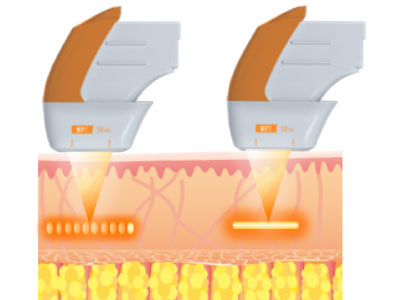
- Two treatment modes: In addition to the conventional dot-pattern delivery (DOT mode), an MP mode that delivers energy in lines has been added. MP mode builds up heat energy at high density and covers a larger area with each pass, which shortens the treatment time.
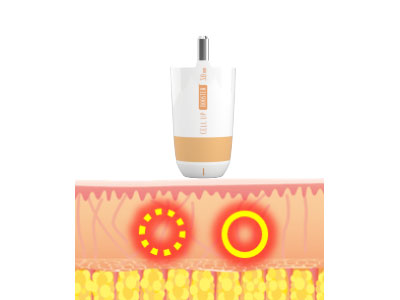
- Pen-type cartridge: The pen-type HIFU cartridge newly added in the MPT delivers energy in a circular pattern, sending high-density energy deep into the dermis. It can also use ultrasonic vibration to help a brightening and skin-care gel (HIFU Booster®) penetrate the skin, allowing skin texture to be addressed along with tightening.
Possible benefits
- Tightening of the jawline
- A slimmer-looking facial contour
- Improvement of sagging of the upper eyelids and under the eyes
- Tightening of a double chin
- Improvement of fine lines on the forehead and neck, and of nasolabial folds
- Improvement of skin texture
Possible side effects
- You may feel a prickling pain or heat during treatment
- Temporary redness or a feeling of warmth may occur
- Welt-like swelling, numbness or reduced sensation may occur
- In rare cases, burns or nerve damage may occur
This treatment is not available if you
- Have heart disease
- Have a pacemaker or an implantable cardioverter-defibrillator (ICD)
- Have silicone, implants, absorbable implants or metal plates (gold threads) in your body
- Have an infection or a severe skin condition (open wounds, severe acne) in the treatment area, or have a bleeding disorder
- Are pregnant, may be pregnant or are breastfeeding
- Are prone to keloids
- Have a fever
About Ultraformer MPT
- Approval status
- Ultraformer MPT is a medical device that has not been approved under Japan’s Pharmaceuticals and Medical Devices Act.
- How it is obtained
- It is imported at the physician’s discretion and under the physician’s responsibility.
- Similar products approved in Japan
- An ultrasound device approved for improving facial and neck wrinkles (the Sofwave system) is available in Japan, but there is no approved product with the same performance as this device.
- Safety information from overseas
- This device has been approved by South Korea’s Ministry of Food and Drug Safety (MFDS) and has CE marking under the EU MDR. Overseas, adverse events of HIFU treatment such as burns, nerve damage and temporary numbness have been reported.
Injections
Wrinkles and sagging are physiological changes that happen to everyone with age. For “small changes” such as making fine lines at the outer corners of the eyes less visible or making the nasolabial folds shallower, you may wish to consider simple treatments with relatively short downtime.
Hyaluronic acid filler
Hyaluronic acid is a substance naturally present in the body. It holds moisture well and helps maintain the skin’s firmness and elasticity, and it is used as a gel-like injectable. It decreases with age, which is one of the causes of wrinkles. Hyaluronic acid injections can make the nasolabial folds shallower.
We use the Juvéderm Ultra series, as well as Voluma, Volift and Volbella.
Advantages
- Results can last for a period of time (varies from person to person)
- The treatment does not take long
- Relatively short downtime
- Low risk of allergic reactions
Possible side effects
- Bruising or redness may occur
- Pain or a foreign-body sensation may occur
- Swelling or raised areas may occur
- Allergic reactions occur in about 0.1% of cases
- In rare cases, if the filler enters a blood vessel, it may cause skin necrosis or visual impairment
About Juvéderm
- Approval status
- The Juvéderm products used at our clinic are medical devices that have not been approved under Japan’s Pharmaceuticals and Medical Devices Act.
- How they are obtained
- They are imported at the physician’s discretion and under the physician’s responsibility.
- Similar products approved in Japan
- Products in the same line, sold as Juvéderm Vista, are approved in Japan.
- Safety information from overseas
- In the United States, Juvéderm Ultra XC, Voluma XC, Volbella XC and Vollure XC (known as Volift outside the US) have been approved by the FDA. Overseas, rare but serious complications such as skin necrosis and visual impairment caused by filler entering a blood vessel have been reported.
Botulinum toxin (BOTOX®)
Botulinum toxin is a protein produced by the bacterium Clostridium botulinum. It reduces muscle activity and has long been used to treat conditions such as blepharospasm (eyelid spasms) and torticollis (wry neck). It can improve wrinkles caused by muscle movement at the outer corners of the eyes, between the eyebrows and on the forehead, and it can also reduce the size of the masseter (jaw) muscles to make the face look slimmer.
Advantages
- Short treatment time, with no wound left behind
- Results can last for a period of time (varies from person to person)
- Relatively short downtime
- Low risk of allergic reactions
Possible side effects
- Muscle volume may decrease
- Facial expressions may become less animated
- Inflammation such as redness or itching may occur
About BOTOX®
- Approval status
- The BOTOX® used at our clinic is a drug that has not been approved under Japan’s Pharmaceuticals and Medical Devices Act.
- How it is obtained
- It is imported at the physician’s discretion and under the physician’s responsibility.
- Similar products approved in Japan
- A drug with the same active ingredient, BOTOX VISTA®, is approved in Japan for glabellar lines (frown lines), crow’s feet and masseter hypertrophy in adults under 65. Forehead lines are not among its approved uses in Japan.
- Safety information from overseas
- In the United States, BOTOX® Cosmetic has been approved by the FDA for glabellar lines, crow’s feet, forehead lines and platysma bands (vertical neck bands); masseter reduction is not among its approved uses in the US. Overseas, adverse reactions such as drooping eyelids, unnatural facial expressions and, in rare cases, difficulty swallowing due to spread of the toxin’s effect have been reported.
- Relief system
- When a drug not approved in Japan is used, Japan’s Relief System for Sufferers from Adverse Drug Reactions does not apply if a serious adverse reaction occurs.
Fat grafting
Fat is harvested from the abdomen or thighs and injected with a cannula into areas of concern on the face, such as wrinkles and hollows. The harvested fat is centrifuged to remove excess oil and impurities, and good-quality fat cells are extracted to improve the survival rate. Fat that survives can remain for a relatively long time (some of the fat is absorbed, and results vary from person to person). It is used for areas such as mid-cheek grooves (lines running diagonally across the cheeks), nasolabial folds, and hollow cheeks and temples.
Sagging around the eyes
The following procedures are used to improve sagging and puffiness of the upper eyelids and under-eye bags, giving the eye area a fresher look.
Upper eyelid surgery (excess skin removal)
The skin of the upper eyelids sags mainly with age. As the sagging progresses, the eyelids not only hang over the eyes and feel heavy, but also narrow the field of vision. As a result, people tend to raise their eyebrows repeatedly without realizing it. This can lead to forehead wrinkles and may also cause stiff shoulders or headaches. This surgery removes the excess skin that causes the sagging.
If orbital fat also contributes to puffiness, the fat can be removed at the same time as the skin.
Please ask about the price at your consultation.
Brow lift (sub-brow excision)
One of the procedures for improving sagging upper eyelids. The incision is made along the lower edge of the eyebrow and excess skin is removed; the scar is usually hard to notice. It improves only the sagging without changing the shape of the eyes, and post-operative swelling is relatively mild. It is suitable for people who are bothered by age-related sagging of the upper eyelids but do not want to change the shape of their eyes.
Upper eyelid micro fat removal (micro-cut method)
Orbital fat in the upper eyelid can be removed through an incision of only a few millimeters, giving the eye area a cleaner look. The incision is placed in an eyelid crease or on the double eyelid line. It is suitable for people with puffy upper eyelids; it is not suitable for people who may develop sunken eyes in the future.
Ptosis surgery (levator aponeurosis advancement)
An incision is made on the double eyelid line, and the levator muscle (the muscle that opens the eye) and its aponeurosis (the part connecting the levator muscle to the eyelid) are shortened by suturing them to the tarsal plate. This opens the eyes wider and also creates a double eyelid. Sagging skin and fat can be removed at the same time.
Lower eyelid surgery (skin and under-eye bag removal)
Excess skin of the lower eyelid is removed near the base of the eyelashes; if the orbicularis oculi muscle is lax, it is tightened with sutures or other techniques before the incision is closed. When orbital fat beneath the eyeball pushes forward with age and forms under-eye bags, the orbital fat is also removed and the orbicularis oculi muscle is addressed, in addition to removing skin. If there is a noticeable hollow under the eyes, fat grafting may be performed at the same time.
Transconjunctival under-eye bag removal: A small opening is made on the inner side of the lower eyelid (the palpebral conjunctiva) to remove the lower orbital fat that causes the bulge. There is no incision on the skin surface.
Hamra technique and transconjunctival Hamra technique: Instead of simply removing the orbital fat, these techniques move it down into the hollow of the tear trough and redistribute it to smooth the area under the eyes. The Hamra technique uses an incision in the skin just below the eyelashes, which allows excess skin to be removed at the same time; the transconjunctival Hamra technique is performed from the inner side of the lower eyelid, with no incision on the skin surface.
All of the above treatments are self-pay (not covered by insurance). For prices, please see our Prices page.